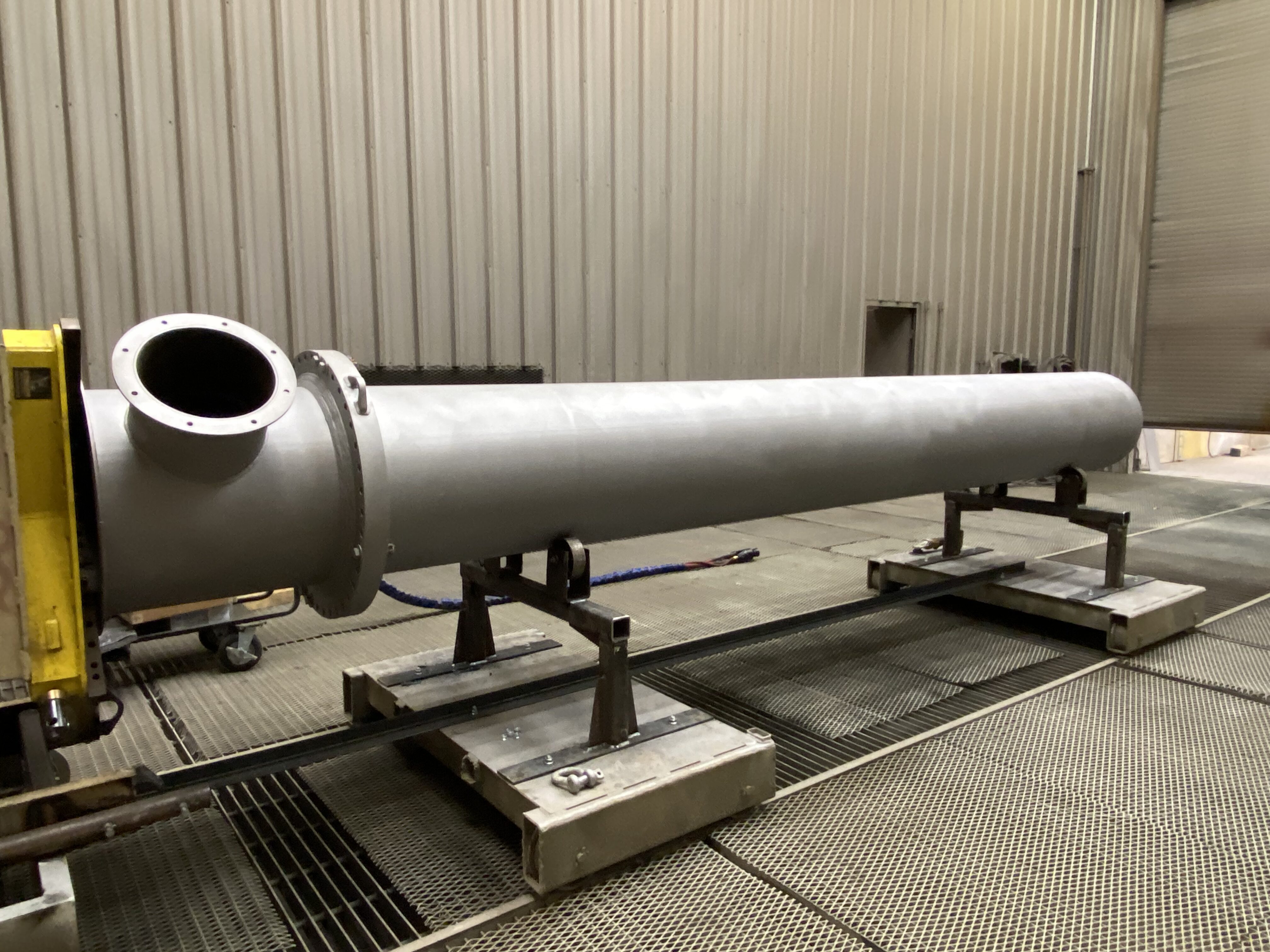
Hess Concentric Firetube Technology
Enhancing Longevity, Efficiency, and Safety in Heater Treater Operations
Improved Firetube Longevity and Performance Through Thermal Arc Spray Technology
A Hess Services Technical Overview and Retrofit Solution for Heater Treater Applications
- Industry Background
Firetubes are critical components in heater treaters, separators, and other production equipment used to condition crude oil and produced water. Their function is to transfer heat from a controlled flame into process fluids — separating water, stabilizing crude oil vapor pressure, and ensuring compliance with conditioning and gas sales temperature specifications.
However, across the industry, firetube failures remain one of the most frequent causes of unplanned shutdowns and maintenance costs. Operators have reported issues including:
- Localized flame impingement, resulting in thinning or burn-through of carbon steel.
- Localized Hot spot, Causing over temperature degradation of A53 Steel and pyrolysis failure of all Epoxy Coatings
- Thermal fatigue cracking at the bend radius of U-tube designs.
- Corrosion and scaling from produced water and acidic condensate accumulation.
- Difficulty maintaining operating temperature within the narrow regulatory range (e.g., 110°F NDIC minimum and 120°F gas sales maximum).
- Poor Heat Transfer with Epoxy Coatings, Epoxy coatings have insulative properties
- Challenges in Conventional Firetube Operation
- Flame Impingement and Overfiring
Traditional firetube designs — particularly straight or U-tube carbon steel models — suffer from concentrated heat exposure near the burner entry. Improper flame tuning, on/off burner cycles, and poor turndown control often result in direct flame impingement, rapidly degrading the inner wall surface.
- Material Limitations and SA53B Steel
SA53B carbon steel is commonly used in conventional firetubes due to low cost, ease of fabrication, and mechanical strength. However, under direct flame impingement and high-temperature operation, it has several critical limitations:
- Rapid Localized Thinning: Direct flame exposure generates temperatures above the nominal range, accelerating oxidation and wall loss.
- Thermal Fatigue Susceptibility: Cyclic heating causes bending stress and microcracking, especially in U-tube configurations.
- Corrosion Vulnerability: Limited resistance to H₂S, CO₂, and condensate results in pitting and accelerated degradation.
- Sacrificial Component Design: Historically, SA53B inner sections were engineered as short-life sacrificial components (~2 years), with outer vessel integrity maintained through inspection.
Alternative Materials: Stainless steel (SS316, SS304) and high-performance nickel alloys (Inconel) provide superior resistance to flame impingement and corrosion but are cost prohibitive for most installations.
- Thermal Cycling and Bending Stress
- In U-tube configurations, repeated heating and cooling induce bending stress at the return radius, which can lead to cracking. Combined with corrosion, this dramatically shortens tube life. Epoxy coatings also have expansion/contraction rates significantly different that underlying steel causing cracking in coating and future corrosion failure points
- Operational Control Challenges
Operators face conflicting constraints:
- NDIC requires oil ≥110°F, monitored via analog vessel logs.
- Midstream gas contracts limit gas to ≤120°F.
- Crude with high GOR and light hydrocarbons undergoes latent heat loss and Joule-Thomson cooling, reducing effective heating in the oil phase.
- On/off-only burner management systems produce saw-tooth temperature swings, complicating regulatory compliance and operational stability. This is amplified with drafting in cold environments.
- The Hess Concentric Firetube Design
Hess Services developed the Concentric Firetube Heater Treater to address these core challenges:
- Uniform Heat Transfer: Concentric design distributes heat evenly, minimizing flame impingement damage to outer pressure boundary with burner flame on internal tube.
- Improved Serviceability: Inner sections are easily inspected and replaced.
- Enhanced Efficiency: Placing the firetube in the oil section maximizes heat transfer. Hot gas directed to external tube disrupts laminar flow and improves heat transfer.
- Reduced internal displacement: Improves retention time
- Code Compliance: Can be manufactured to ASME Code.
- Standard Gaskets: Firetube uses Standard ASME Flange sizes and gaskets.
- Thermal Arc Spray Coating Technology
Thermal Arc Spray Coating deposits a dense metallic layer of C276 nickel alloy with Patented Proprietary sealant onto the firetube surface, enhancing corrosion resistance and heat transfer characteristics.
Benefits
- Corrosion Protection: Protects against oxidation, scaling, and condensate attack.
- Thermal Shock Resistance: Coating expands with the substrate, minimizing cracking from cyclic heating.
- Improved Heat Flux Distribution: Increases emissivity, reducing hot spots.
- Extended Service Life: Typically, 5× longer than uncoated carbon steel. Some firetubes have been in services since 2018.
- Cost-Effective: Significantly lower cost than using Specialty Alloy pipe to construct firetube
Retrofit Strategy
Recognizing that most U-tube firetubes in the field are still SA53B, Hess offers a retrofit solution to extend lifespan without full replacement:
- Apply Thermal Arc Spray coating to the existing U-tube surface.
- Install stainless steel lick plates near the burner entry to deflect direct flame.
- Add ceramic firetube inserts to distribute heat evenly and mitigate direct flame impingement.
This approach allows operators to achieve longer service intervals, reduced failures, and stable operation, even in older installations, while targeting new builds with the improved concentric design.
- Summary of Benefits
Feature | Benefit |
Hess Concentric Firetube | Uniform heat flux, reduced flame impingement |
Thermal Arc Spray Coating | Corrosion resistance, thermal shock protection, extended lifespan |
Stainless Lick Plates & Ceramic Inserts | Protect against direct flame, improve heat distribution |
Retrofit Capability | Upgrade existing U-tube firetubes without full replacement |
Extended Service Life | Significantly longer life than uncoated SA53B |
- Conclusion
Hess Services offers a comprehensive solution to the persistent challenges of firetube operation:
- New construction: Concentric firetube design eliminates the limitations of SA53B inner tubes.
- Retrofit market: Thermal Arc Spray coatings combined with stainless steel plates and ceramic inserts provide cost-effective, extended life for existing U-tube firetubes.
These solutions enhance operational reliability, reduce downtime, and provide regulatory compliance, while balancing cost and performance across both new and legacy installations.